
When you come to Neuroworks Chiropractic Clinic, with a condition that’s troubling you, we look at you as a whole person.
Traditionally research and treatments only focus on the bodily tissue where the patient feels pain.
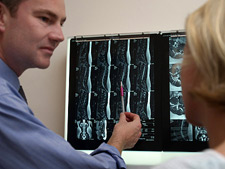 At Neuroworks we not only look at where you tell us the pain is, but we also look at all the nerve connections between the site of pain and the brain where the pain is really ‘felt’. The brain, not the tissues, feels pain. A person can feel pain without tissue injury, and the intensity of pain need not always reflect the tissue injury. Traditionally where there is no obvious peripheral or visceral damage, a solution is generally not offered for the patient’s pain.
Current thinking and research suggest areas within the CNS may become sensitised to pain and continue to transmit the sensation of pain without a tissue pathology. This is particularly true in more complex and chronic pain cases, and it is important to treat both acute and chronic pain as soon as possible to avoid ongoing unnecessary symptoms. In these cases the regions of brain and the nervous system that represent the painful part of the body are often no longer healthy enough to suppress the pain. Alternatively central sensitisation could be signalling pain falsely.
We would all be in constant pain if our brain did not suppress it. Unfortunately, in later life the degeneration of brain cells with age or disuse, makes us less able to suppress pain sensations. We are also less able to co-ordinate muscles during movement and may sprain and strain muscles that further sensitise us to pain. Alongside this we have a greater likelihood of pain from, for example osteoarthritis in joints, from wear and tear.
Many people may have the same type and location of pain but for very different reasons. One person for example may have very arthritic joints on X-Ray, but have no pain, whilst another suffers unbearably for no apparent reason.
At Neuroworks we address not only the pain site in the body but we also look at how the nervous system may produce or react to it. We use this information to plan holistic treatment that reduces pain, optimises function and prevents recurrence.
-
Musculo-skeletal conditions
-
Joint stability results from both ligament strength and muscle tone. When we exercise a muscle, we affect the muscle itself as well as creating more nerve connections to that muscle throughout the relevant parts of the nervous system.
In fact simply thinking about a movement, primes our brain to tone the relevant muscles and increase blood supply. At the same time the brain also increases connections amongst the relevant nerve cells. The brain becomes thereby ‘more aware’ and better co-ordinated(less dyspraxic/ dysmetric), and injury of the body part becomes less likely.
Maintaining a healthy nervous system will lessen arthritic changes in joints and enhance our performance over a greater time span. A person with a healthy nervous system will adjust more quickly to, say, an uneven footing. They will be less prone to ankle sprains as well as recovering faster. In the same way they would be less prone to injuries such as whiplash in a car accident.
Each hemisphere of the brain influences how particular parts of our body works. One side of the brain sets the tone for all muscles and tendons on the same side of the body. This may seem strange as traditionally most of us were taught that one side of the brain sends information to the other side of the body to move voluntary muscles.
In fact each side of the brain primes small muscle fibres within each muscle to create the correct tension so that the opposite side of the brain can provide the appropriate movement when needed. The fact is 90% of the brain’s output to the body is on the same side. At the same time the brain also helps to initiate more general functions including toning blood vessels, digestive muscles, sweat glands, heart rate & rhythm, tearing, and glandular secretions.
Neuroworks’ treatments aim to strengthen the functioning of the nervous system. This not only addresses specific problems but also enhances general well-being. And that’s not all, our approach can also give sports people that vital competitive edge, as well as helping prevent injury and improve reaction times and co-ordination. Neuroworks’ integrative way of tackling pain also helps in cases of repetitive sprain or strain injuries (RSI) and occupational injuries.
Let’s look at the example of back injury, one of the most common causes of pain to explain how Neuroworks understands and approaches a condition. The spine is particularly prone to pain. It’s hard to believe, but the nerve receptors in our thumb connect with about the same volume of our brain as the whole of the lower back.
This is because our hands are so important to us for motor control and sensing and our back is not! So it is harder for the sufferer to be aware of trouble developing in the back.
People have no awareness of individual vertebrae nor discs, which have very few pain receptors. Back pain often comes after a long period of poor functioning and degenerative change.
The smaller spinal muscles (spinal intrinsic) that run between individual vertebrae, hold the spine together and protect from sprain or strain injury. They function at the command of the cerebellum, which analyses incoming information. (The information comes from a wide range of sources: vision, balance receptors in the ear, sensory information from the body and brain.) The cerebellum then decides (sub-consciously) the most appropriate muscular response for the spine.
So if one side of the cerebellum is under-active this may greatly increase our risk of back injuries and lead to wear and tear of spinal tissues. If you come to Neuroworks with back pain we will rehabilitate the larger muscles of the spine, and just as importantly enhance those parts of the nervous system that keep us from hurting ourselves. This approach generally gives more lasting results because we encourage the body to learn to protect itself.
Pain
- Headaches and migraine
- Jaw and facial pain
- Spinal pain, neck, mid back, lower back and pelvic pain
Osteoarthritis, degenerative changes, ‘trapped nerves’, stenosis, spondylolisthesis, ‘slipped’ discs, healed fractures, pulled muscles, stiff joints, scoliosis.
- Chest, shoulder and arm pain
Rib pain, frozen shoulder, rotator cuff injury, sub-acromial impingement syndromes, bursitis, capsulitis, trapped nerves, tennis elbow, golfer’s elbow, repetitive sprains/strains (RSI), wrist and hand problems.
- Hip, knee, ankle and foot pain
Hip joint and muscle problems, sciatica, hamstring, quadriceps and calf muscle/tendon injury, groin strains, patellar (knee-cap) tracking syndromes, knee cartilage (meniscus), ligament damage, Achilles tendon pain, heel, spurs (plantar fasciitis), metatarsalgia, ankle sprains.
- Muscle and joint pain
Stiffness, cramps, spasms, pins and needles, burning, aching, stabbing pains.
- Trapped nerves
Nerve palsies e.g. carpal tunnel syndrome, sciatica, radicular entrapments.
- Pain Syndromes
Central and Peripheral sensitisation syndromes.
