
When you come to Neuroworks Chiropractic Clinic, with a condition that’s troubling you, we look at you as a whole person.
We do not appreciate our senses of balance and spatial awareness until we lose them.
Most people, particularly young to middle age people, are unaware that they have some degree of a balance disorder. Postural stability takes many years to train through childhood development and involves a range of senses. Once we achieve a satisfactory level of balance for us to function adequately in every day life, we no longer need to be conscious of it. In normal circumstances the CNS compensates for the common low functioning in one or two of the sensory systems involved in balance. We do not become aware of problems until we get older or after injury.
Under functioning of any part of the balance systems may result in dizziness, giddiness, vertigo, dissociation, visual problems, falls and clumsiness. It may also be closely associated with such symptoms as fatigue, headache or tight muscles. This is because other brain systems have to work harder to compensate.
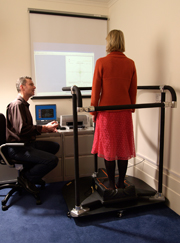 At Neuroworks we assess your balance or risk of falling within 60 seconds using the Computer Assisted Postural System (CAPS). Then we find the cause by assessing your falls history, gait, mobility, muscle strength, vision, sensory feedback, and vestibular (inner ear) systems. We also check your hearing, cognitive and neurological health, cardiovascular health, fear of falling and home hazards.
Most medications geared toward the prevention of dizziness and disequilibria (vestibular suppressants, anti-emetics, anti-cholinergics, sedatives and tranquillizers) hinder the body’s natural compensation process. In patients with chronic balance problems only vestibular rehabilitation has been shown to improve balance function and performance when compared to medication or general exercise.
Neuroworks offers vestibular rehabilitation to address balance and coordination problems.
Reduced reaction times are the leading cause of falls, which are the major cause of accidental death (31%) in the over 65’s. Nearly 50% of elderly patients with hip fracture die within one year. We believe we can reduce the risk of falling in this group by 50%. Assessing balance is not only useful for the elderly, but is also important for sports people and of course for all of us in day-to-day life.
The nervous system and balance and coordination conditions
- Balance disorders
Falls, dissociated feelings, spinning, disequilibrium, light headedness, dizziness, giddiness, Benign Paroxysmal Positional Vertigo, Meniere’s Disease.
- Sports enhancement
Improvement of balance and co-ordination. Optimal performance and preventative treatment of injuries.
