
- Treatment explained ›
- Examination & Assessment ›
- Equipment ›
- Treatment ›
- The Nervous System and your Well-being ›
As a Neuroworks patient you can expect to receive special attention. You will follow an individual path through assessment to treatment and review, tailored to your needs.
At Neuroworks we use some of the latest scientifically- and clinically-proven equipment to help assess, diagnose and treat our clients. Here we explain technologies you might not be familiar with.
-
Computer Assisted Postural System (CAPS)
-
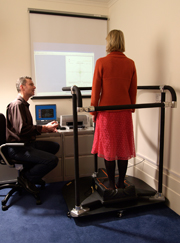 We may use this to assess your balance and any related problems. The machine consists of a balance platform that you stand on, surrounded by a safety frame. This device is connected to an array of electrical monitoring equipment and a computer to process information.
For screening checks we ask you to close your eyes for 30 seconds while the computer analyses you balancing ability. CAPS is an extremely accurate device that tells us your likelihood of falling, which way you sway and where your centre of balance is. We also use the machine to monitor your progress as treatment proceeds. We correlate your results with other people of your age and height and generate a report, which guides treatment of your condition.
We also use CAPS as a treatment device. For this purpose we ask you to maintain balance to the best of your ability on a particular area of the soft cushion. The CAPS machine projects a grid on a screen in front of you, which identifies your centre of balance and guides you to strengthen your balance by adjusting your stance. We can also use this equipment for younger people or athletes who want to maximise their balance beyond normal levels. We make the exercises more challenging, for example by asking them to change their foot stance or head position.
Interactive metronome
This device involves using a computer-based program for assessment and rehabilitation. The program challenges you to synchronise a range of hand and foot exercises to a precise tone heard through headphones. Sensors analyse your actions as you attempt to match the rhythmic beat with repetitive movements. In the first case it helps us assess your condition, and repeated use helps you improve your coordination and strengthen relevant parts of your nervous system. We monitor your progress as therapy continues.
-
Visual acuity device
-
We assess the acuteness of your eyesight by using a Snellen tumbling ‘E’ test. We ask you to stand six feet from a computer screen, which shows the letter E in different orientations and in differing sizes. All you need to do is tell us which way it is pointing. This very simple test gives us a lot of helpful information about your visual acuity.
Video Nystagmography device (VNG)
This is a very sophisticated device that we use to gain understanding of your brain function in many different areas, by observing the function of your eye muscles during movement. The device was pioneered by NASA to assess the adaptation of astronauts’ nervous systems in zero-gravity environments. It has now been adapted to give us relevant information about the nervous system back on earth. When we use it at Neuroworks it helps us assess a range of conditions.
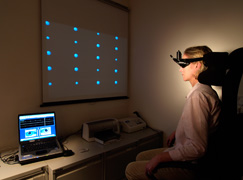 To use the machine, we ask you to put on infrared camera goggles and very sensitive head movement sensors. Then we invite you to view static or moving cursors projected in front of you. As you perform about 20 different tests information is fed to a computer, which records and graphs the actions of your eyes.
Middle ear tests
-
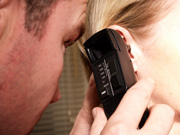 If we suspect a middle ear condition we may also use air caloric testing. In this test warm or cool air is blown into your ear while we observe eye movements using the Video Nystagmography device (VNG).
VORTEQ Testing
-
This test is also used for suspected middle ear conditions. The VORTEQ is an extremely sensitive and ultra-light movement sensor that fits onto the VNG goggles. We will ask you to move your head at varying speeds while you focus on a cursor. The computer will then calculate whether your eye movements are correct for the amount of head movement, This helps us assess individuals who feel dizzy while moving, and also ball-sports people who need to focus on a moving object.
